
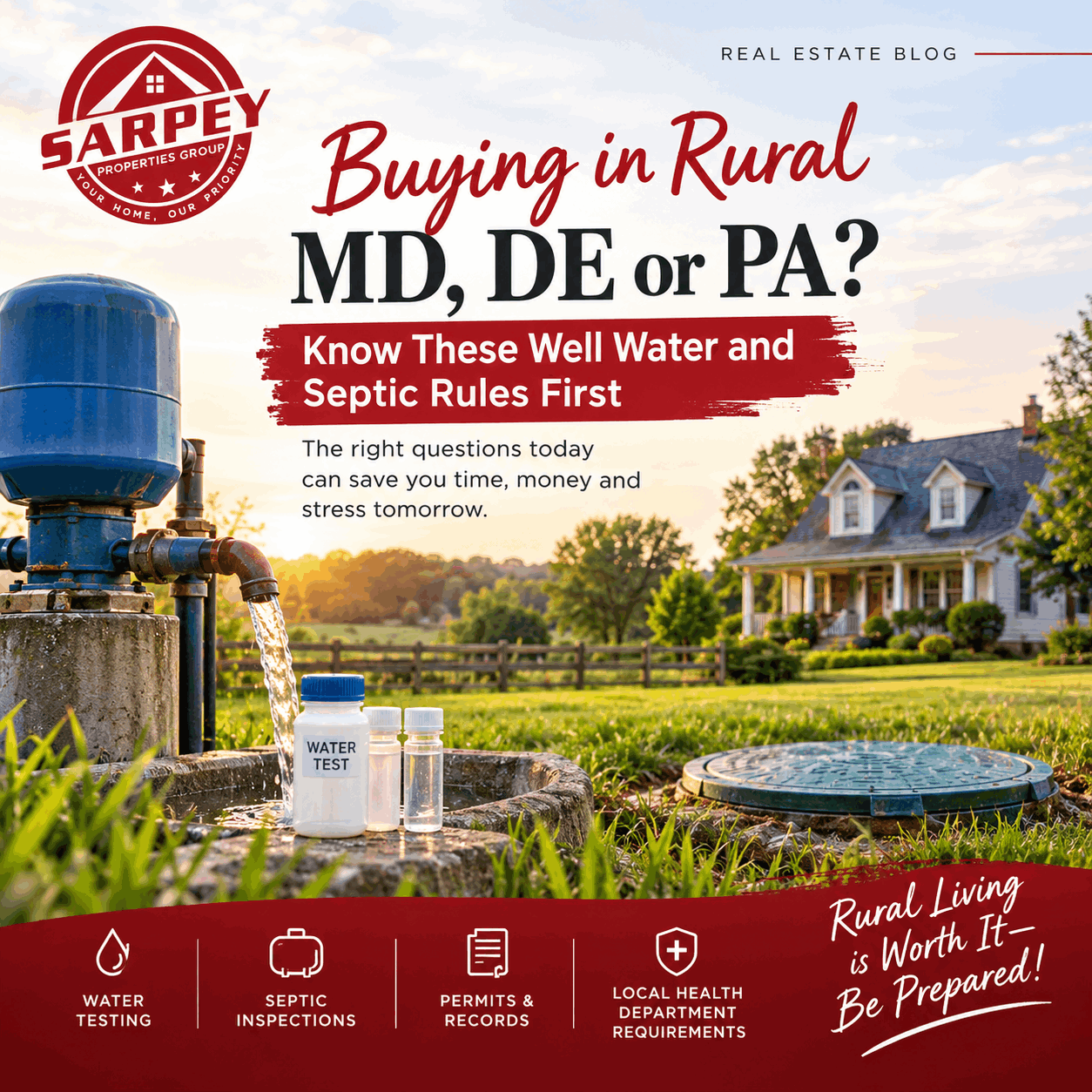
Buying in Rural MD, DE or PA? Know These Well Water and Septic Rules First
Buying in Rural MD, DE or PA? Know These Well Water and Septic Rules First
Imagine finding your dream country home. You have the peaceful surroundings, the extra acreage, the privacy you have always wanted, and maybe even the perfect space for a garden or backyard gatherings.
It feels like the one.
But before you picture yourself settling in, there are two important things you should understand about the property: where your water comes from and where your wastewater goes.
Many rural homes in Maryland, Delaware, and Pennsylvania rely on private wells for drinking water and septic systems for wastewater treatment. These systems can work well for years when properly maintained, but they also come with responsibilities that buyers should understand before closing.
And here is the thing: you do not need to be an expert in wells or septic systems to make a smart buying decision. You simply need to know the right questions to ask.
First, Find Out What Systems Serve the Property
Not every rural home operates the same way. Some properties use a private well and septic system, while others may connect to a public water supply, a public sewer system, or a combination of different services.
Before moving forward, ask the seller or listing agent which systems serve the home. If the property has a private well or septic system, find out where the equipment is located, how old the systems are, and whether the seller has records of previous inspections, repairs, or maintenance.
Why does this matter? Because these details can affect your ongoing expenses, maintenance responsibilities, and future plans for the property.
For example, if you are buying a home with a large backyard and envision adding an outdoor structure or expanding the house later, the location of the septic system and its drain field may influence what is possible. Never assume that unused land is automatically suitable for construction.
A little information upfront can save you from making assumptions that become expensive later.
Private Well Water: Is It Safe to Drink?
When a home relies on a private well, water quality deserves special attention.
Unlike water supplied by a regulated public water system, private well water generally is not monitored by a public water utility on an ongoing basis. The homeowner is responsible for ensuring that the water is tested appropriately and that the well is properly maintained.
Clear water does not necessarily mean safe water. Some contaminants cannot be seen, smelled, or tasted.
That is why buyers should arrange appropriate water testing through a qualified laboratory or water-testing professional. Depending on the property's location, history, and local recommendations, testing may include bacteria such as coliform and E. coli, nitrates, and other contaminants relevant to the area.
Ask whether recent water-testing results are available, but do not rely solely on an old report. Consider arranging your own testing as part of the purchase process, and discuss any concerning results with qualified professionals before proceeding.
If the results identify a problem, do not panic. Some issues may be manageable with appropriate treatment or repairs. The important thing is to understand the findings, the potential cost of addressing them, and whether the water will be suitable for your household.
Your future home should provide peace of mind—not unanswered questions about the water coming out of your tap.
Septic Systems: What Buyers Need to Know
A septic system treats household wastewater on the property. Depending on its design, it may include a septic tank, distribution components, and a drain field or other approved treatment area.
When a system is functioning properly and maintained according to its requirements, it can serve a home for many years. However, neglected maintenance, damaged components, unsuitable site conditions, or an aging system can lead to expensive problems.
Before buying, arrange an appropriate septic inspection by a qualified professional. Ask about the system's condition, maintenance history, known repairs, and whether there are any signs of failure or concerns that require further evaluation.
Also ask for available septic permits, system approvals, repair records, and pumping receipts. These documents can help establish what system was installed and what work has been performed, although records alone do not guarantee that the system is currently functioning properly.
Pay attention to the drain field, too. Its location and condition may affect landscaping, vehicle access, additions, and other improvements you might want to make.
If an inspection identifies a concern, get a professional explanation of what it means and whether additional evaluation is needed. Depending on the issue, you may need to discuss repairs, further testing, or other options with the seller before closing.
The goal is not to rule out rural properties. It is to understand what you are buying and avoid unpleasant surprises after you move in.
Don't Skip Permits, Maintenance Records, and Local Requirements
Here is where buying in Maryland, Delaware, or Pennsylvania requires a little extra attention: requirements can vary by state, county, and local jurisdiction.
A property that meets one area's requirements may be subject to different procedures or standards somewhere else. Rules may also differ depending on the system, the property's history, and whether you are buying an existing home, renovating, or planning an addition.
Ask for the available well and septic records, including permits, installation or repair documentation, water-test results, and maintenance history. Then verify the property's records and applicable requirements with the appropriate local or county health department and other relevant authorities.
Depending on the location and circumstances, you may need to confirm whether an inspection, water test, septic evaluation, permit review, or other approval is required for the transaction.
Do not assume that a system is approved simply because it has been in use for years. Likewise, do not assume that missing paperwork automatically means the system is defective. Have the appropriate local authority and qualified professionals help clarify the situation.
If you are planning to expand the home, add a bedroom, build an accessory structure, or make other significant changes, ask about applicable requirements before committing to those plans. Existing well and septic arrangements can affect what a property can accommodate.
What If the Inspection Reveals a Problem?
Finding an issue does not automatically mean you should walk away from the property. It means you need reliable information before deciding what to do next.
Start by understanding the inspection findings and obtaining estimates or recommendations from qualified professionals. Then review your purchase agreement and applicable deadlines with your real estate agent so you understand your options.
Depending on the circumstances and the terms of your agreement, you may be able to discuss repairs, request additional evaluations, negotiate an appropriate adjustment, or consider other available options.
The key is timing. Discovering a concern early gives you more opportunity to evaluate it and make an informed decision before closing.
This is also why having a knowledgeable real estate professional matters. Your agent can help you identify the questions that need answers, coordinate with the appropriate parties, and keep important deadlines on your radar. Specialized testing, technical evaluations, and legal or regulatory interpretations should still come from the qualified professionals responsible for those matters.
A Smarter Way to Buy Rural Property in MD, DE, and PA
Rural living offers plenty to love: more privacy, open space, scenic surroundings, and the freedom to enjoy a different pace of life. But buying outside a public water and sewer network means understanding a few additional responsibilities.
Before you fall completely in love with a property, take the time to confirm which systems serve it, arrange appropriate water testing and septic inspections, review available records, and check the requirements that apply to that specific location.
You are not just buying a house. You are investing in the systems, land, and long-term responsibilities that come with it.
At Sarpey Properties Group, we believe informed buyers make more confident decisions. Whether you are exploring a quiet country home in Maryland, looking for more space in Delaware, or considering a rural property in Pennsylvania, having the right questions—and the right real estate guidance—can help you navigate the process with greater confidence.
Our goal is to help you look beyond the listing photos, understand the details that matter, and move toward a property that fits your needs and long-term plans.
Thinking about buying a rural home in MD, DE, or PA? Before you make your move, let's talk about your plans and the questions you should be asking.
Visit www.sarpeypropertiesgroup.com to connect with Sarpey Properties Group and take your next step toward a more informed home purchase.
Important note: This article is for general educational purposes and is not a substitute for property-specific inspections, laboratory testing, or guidance from the relevant local authorities. Requirements vary by jurisdiction and property.
Categories
- All Blogs (42)
- 2026 Housing Market (2)
- Buyer Education (3)
- Buyer Resources (9)
- buyer strategy (4)
- Buyer tips (6)
- buying power (2)
- buying power, (1)
- Buying Tips (4)
- Client success stories (2)
- delaware home (1)
- Delaware Real Estate (27)
- delaware realtor (3)
- energy efficiency (1)
- First time home buyer (11)
- home affordability (2)
- Home buyer (10)
- Home buying (20)
- Home Buying & Selling (3)
- home buying and selling (20)
- home buying tips (9)
- home financing (3)
- home improvement (1)
- home inspections (3)
- home owner tips (2)
- home ownership (4)
- home seller tips (2)
- home sellers (2)
- home selling (10)
- home selling tips (11)
- home staging (3)
- home valuation (6)
- homebuyer tips (1)
- Homeownership (10)
- Homeownership Buyer Education (2)
- house (7)
- house buying guide (7)
- house hunting (7)
- housing market forecast (2)
- housing market trend (4)
- interest (4)
- interested rates (3)
- Landlord Tips (1)
- Lifestyle & Community Guides (1)
- Location & Lifestyle (1)
- market (7)
- market, (1)
- maryland home (2)
- Maryland Real Estate (29)
- maryland realtor (4)
- mortgage (5)
- mortgage and financing (6)
- mortgage approval (2)
- mortgage loans (1)
- open house tips (2)
- pennsylvania home (2)
- Pennsylvania Real Estate (28)
- pennsylvania realtor (3)
- property (1)
- property maintenance (1)
- Real Estate Advice (20)
- real estate education (1)
- Real Estate Investment (2)
- Real Estate Market Insights (8)
- real estate market trends (2)
- real estate marketing (7)
- real estate negotiation (4)
- Real Estate Planning (2)
- real estate professionals (9)
- real estate selling tips (4)
- Real estate tips (15)
- Real estate, (15)
- Relocation & Moving (2)
- rental properties (1)
- residential real estate (4)
- rural property buying (1)
- Sarpey (11)
- Sarpey Properties Group (12)
- seller preparation (1)
- seller resources (7)
- seller strategies (2)
- seller strategy (1)
- Selling vs Renting (1)
- tax (3)
- Tri-State Real Estate (3)
- wealth building (3)
Recent Posts









"My job is to find and attract mastery-based agents to the office, protect the culture, and make sure everyone is happy! "