

Before You Sign That Builder Contract: 12 Questions Every New Construction Buyer Should Ask
Before You Sign That Builder Contract: 12 Questions Every New Construction Buyer Should Ask
Sarpey Properties Group | Real Estate Buyer Education | Delaware • Maryland • Pennsylvania
Your dream home may be brand-new, but that doesn't mean the contract is risk-free. Here's what every buyer should know before putting pen to paper.
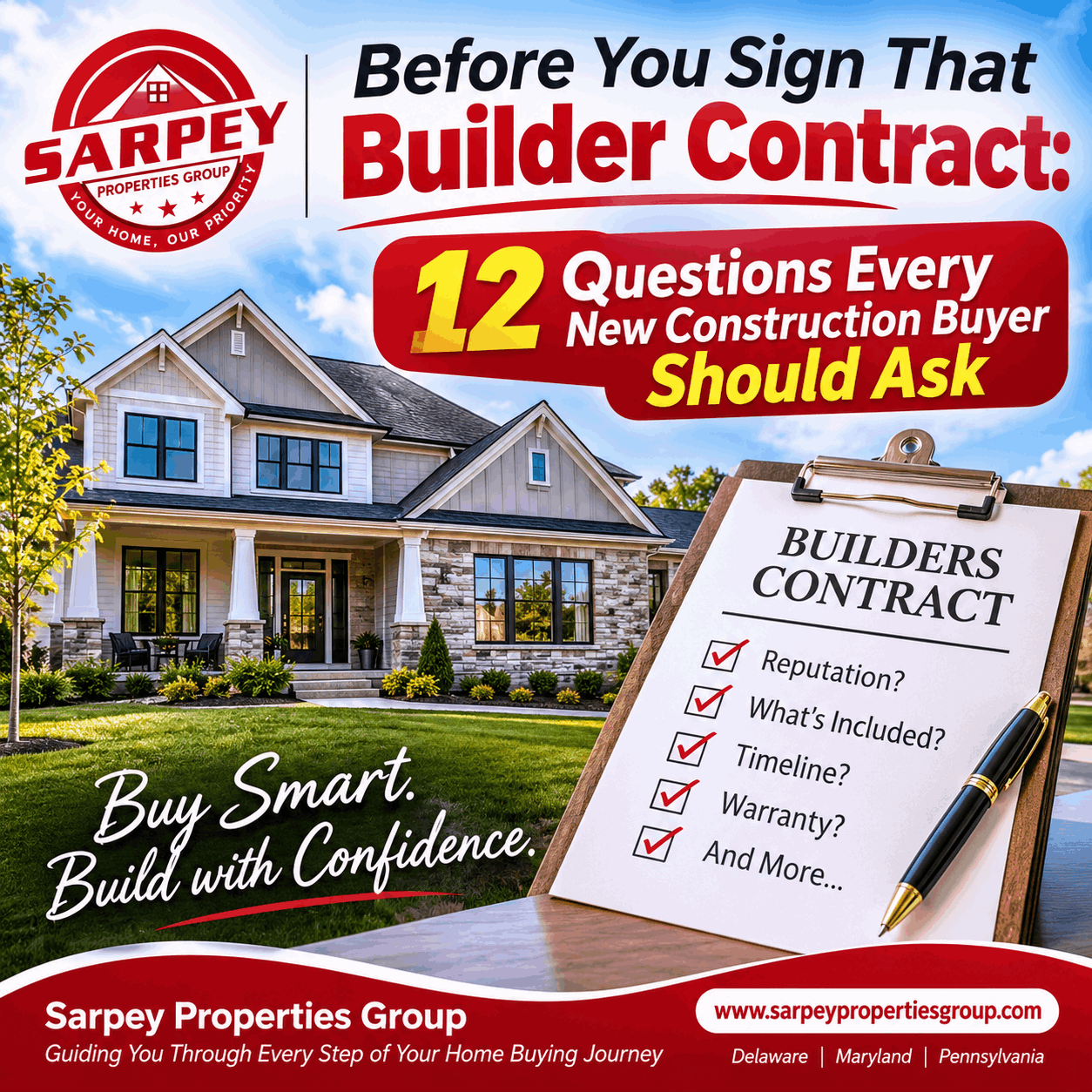
Imagine walking into a beautiful model home. The kitchen is stunning, the floors are exactly what you've been looking for, the bathrooms feel like something out of a luxury magazine, and everything looks brand-new.
You can already picture your furniture in the living room and family gatherings around the kitchen island.
The builder offers an attractive incentive, the sales representative tells you the community is selling quickly, and suddenly, you're being encouraged to sign the purchase agreement.
Exciting? Absolutely.
But here's something every buyer should remember: Falling in love with a model home is easy. Understanding the builder contract is where things get serious.
Buying new construction is different from purchasing an existing home. You're not simply buying a property that's already built. You're entering into an agreement that may involve construction schedules, material selections, upgrade costs, deposits, inspections, warranties, and obligations that could continue for months before you receive your keys.
And while a brand-new home may mean fewer immediate maintenance concerns, it doesn't automatically mean fewer financial or contractual risks.
Before you sign, take the time to ask the right questions. These 12 questions can help you protect your investment, understand your responsibilities, and avoid unpleasant surprises along the way.
1. Is the Builder Reputable, Experienced, and Properly Registered?
Before discussing countertops, flooring, or kitchen upgrades, start with the company responsible for building your home.
How long has the builder been operating? How many homes have they completed? Can they provide references from previous buyers? Have there been complaints involving unfinished construction, delayed projects, or unresolved warranty issues?
Don't rely exclusively on beautifully staged model homes or impressive marketing materials. Ask to see completed properties, speak with previous customers when possible, and research the builder's reputation independently.
You should also verify whether the builder meets applicable state registration or licensing requirements.
For example, Maryland generally requires home builders to register with the Maryland Attorney General's Consumer Protection Division before entering into contracts with consumers for the construction or sale of new homes, subject to limited exceptions. Buyers can check the state's registered builder information before committing.
In Delaware and Pennsylvania, buyers should also verify the appropriate business credentials, contractor qualifications, permits, and applicable local requirements for the specific project.
Remember: A builder's reputation is part of your investment. A beautiful home means very little if the company behind it cannot deliver what was promised.
2. What Exactly Is Included in the Base Price?
Here's where buyers sometimes get caught off guard.
The model home looks incredible, but is everything you're seeing actually included in the advertised purchase price?
That upgraded kitchen island, hardwood flooring, decorative lighting, finished basement, premium countertops, or landscaped backyard may be considered additional features.
Some builders use model homes to showcase optional upgrades that can substantially increase the final cost.
Ask the builder to provide a detailed breakdown of what comes standard and what requires an additional payment. Request written specifications covering flooring, cabinetry, appliances, plumbing fixtures, lighting, windows, exterior finishes, landscaping, and other major features.
Also ask whether the quoted price includes driveway installation, sod, fencing, a deck, a patio, or other site improvements.
Don't assume that something displayed in the model home automatically comes with your purchase.
A good rule of thumb: If it's important to you, make sure it's documented in writing.
3. Are There Additional Lot Premiums or Site Preparation Costs?
Not all lots are created equal.
A corner lot, wooded lot, larger homesite, cul-de-sac location, or property with a particularly desirable view may carry an additional premium.
But the location isn't the only thing you should evaluate.
Ask whether the lot requires additional grading, drainage improvements, retaining walls, tree removal, soil preparation, or other site work. These factors can influence both the final cost and the property's long-term maintenance requirements.
You should also investigate easements, utility access, stormwater management, drainage patterns, and any applicable homeowners association restrictions.
For buyers in Delaware, Maryland, and Pennsylvania, local site conditions can vary considerably. Depending on the property, it's worth asking about flood exposure, wetlands, septic systems, private wells, and other environmental or infrastructure considerations.
A lot that looks perfect during a sunny afternoon visit may present a different picture after heavy rainfall.
Before committing, understand exactly what you're purchasing beyond the house itself.
4. When Will the Home Be Completed, and What Happens if Construction Is Delayed?
One of the biggest mistakes buyers can make is planning their entire move around a completion date that hasn't been firmly guaranteed.
Ask the builder for an estimated construction timeline and, more importantly, understand how that timeline is addressed in the contract.
Does the agreement specify a target completion date? Are there provisions allowing extensions for weather, labor shortages, supply-chain disruptions, permitting issues, or other circumstances?
What happens if the home isn't ready when expected?
This matters particularly if you're selling your current property, arranging temporary accommodation, coordinating a relocation, or planning around a school schedule.
You should also clarify whether the builder has any contractual obligation to compensate you for certain delays. Never assume that a projected completion date automatically creates a guaranteed move-in date.
Your moving plans should be based on the contract, not simply on a verbal promise.
5. How Much Is the Deposit, and Is It Refundable?
Before handing over thousands of dollars, make sure you understand exactly how the builder handles deposits.
Ask how much is required upfront, whether additional deposits are due during construction, where the funds will be held, and under what circumstances you may receive a refund.
Some builders have strict cancellation provisions, while others may allow certain protections depending on the circumstances and contract terms.
Pay close attention to what happens if:
-
Your mortgage financing is denied.
-
The appraisal comes in below the agreed purchase price.
-
You cannot sell your existing home.
-
The builder fails to complete the property as agreed.
-
You decide to withdraw from the purchase.
Also, ask whether design and upgrade deposits are treated differently from the initial purchase deposit.
Do not assume that a deposit is automatically refundable simply because construction has not started.
Have the applicable deposit and cancellation provisions reviewed before signing. The amount of money you could potentially lose makes this one of the most important conversations to have.
6. Can the Builder Change Materials, Designs, or Construction Specifications?
You selected a particular floor plan, chose your finishes, and agreed to a specific set of features. But what happens if the builder cannot obtain the materials originally specified?
Some construction agreements allow builders to substitute materials or make design changes under certain circumstances.
The important question is: How much freedom does the builder have to change what you're paying for?
Ask whether substitutions require your approval, whether replacement materials must be of comparable quality, and whether you will be notified before significant changes are made.
You should also clarify whether structural changes, room dimensions, window placements, cabinetry, and other important design elements can be modified without your written consent.
If you request changes during construction, ask how those requests are documented and priced.
This brings us to another important detail: change orders.
Every approved modification should be clearly documented, including the additional cost, payment requirements, and any impact on the construction schedule.
Avoid relying on verbal agreements or casual conversations with the sales representative. If a promise matters to you, get it included in the written agreement or an appropriately executed contract addendum.
7. Can You Hire an Independent Home Inspector During Construction?
A brand-new home still needs to be inspected.
In fact, having the opportunity to examine the property at different stages of construction can help identify issues before walls are closed, finishes are installed, and the home is ready for occupancy.
Ask whether the builder permits independent inspections during construction and whether you can arrange inspections at key stages, such as:
-
Before the foundation is covered.
-
After framing and before drywall installation.
-
Near substantial completion.
-
During the final walkthrough.
The builder may already conduct internal quality-control inspections, but those are not necessarily a substitute for an independent professional evaluation.
Also, ask whether you can receive copies of applicable inspection reports, permits, approvals, and certificates required for occupancy.
Most importantly, understand whether your independent inspection rights are specifically addressed in the contract.
Some builders impose scheduling requirements or limitations on when third-party inspectors may access the construction site. Clarify these rules before signing.
Don't wait until closing day to discover problems that could have been identified much earlier.
8. What Does the Builder's Warranty Actually Cover?
One of the biggest selling points of new construction is the warranty.
However, not all warranties offer identical protection.
A builder may provide separate coverage for workmanship, materials, mechanical systems, and structural components. The coverage period, exclusions, claim procedures, and responsible parties can vary.
Ask the builder:
What is covered during the first year? Are plumbing, electrical, heating, and cooling systems covered separately? What structural defects qualify for coverage? Who handles warranty claims? How quickly must problems be reported?
Also, request a complete written copy of the warranty before signing.
Pay particular attention to exclusions involving normal wear and tear, improper maintenance, landscaping, drainage, cosmetic defects, and damage caused by circumstances outside the builder's responsibility.
For Maryland buyers, this question deserves additional attention.
Maryland's new home warranty laws establish requirements involving builder disclosures and qualifying new home warranty security plans. Depending on the arrangement, statutory minimum coverage can include one year for materials and workmanship, two years for specified mechanical systems, and five years for qualifying structural defects.
Builders who do not participate in an approved warranty security plan have separate disclosure obligations. Buyers should carefully review those disclosures rather than assuming that every newly constructed home carries identical warranty protection.
For Delaware and Pennsylvania buyers, review the actual written warranty, applicable statutory protections, and any relevant contractual remedies. Do not assume Maryland's warranty framework applies in those states.
9. Are You Required to Use the Builder's Preferred Lender?
Many builders offer incentives for buyers who use their preferred mortgage lenders.
These incentives may include closing cost assistance, upgrade allowances, or promotional financing arrangements.
While these offers can be attractive, don't automatically assume they're the best financial option.
Ask whether using the preferred lender is mandatory or optional, whether the incentive changes if you choose another lender, and whether the quoted interest rate includes discount points or other costs.
Compare the complete loan estimates, not just the advertised interest rate.
Look at lender fees, interest rates, mortgage insurance, closing costs, and the estimated cash required at settlement.
You should also ask what happens if your financing is delayed or denied and whether the builder's contract contains a financing contingency.
This is especially important because a builder's preferred lender incentive may not necessarily outweigh the savings available through another mortgage provider.
A little comparison shopping could make a meaningful difference to your long-term housing expenses.
10. What Happens if You Need to Cancel or If the Builder Fails to Meet Its Obligations?
Nobody enters a new construction agreement expecting things to go wrong. However, responsible buyers prepare for possibilities before they become problems.
Carefully review the contract's default, cancellation, termination, and dispute-resolution provisions.
What happens if you fail to make a scheduled payment? What happens if the builder cannot complete the home? Can either party terminate the agreement, and under what conditions?
You should also examine the dispute-resolution process.
Does the agreement require mediation or arbitration? Are there specific notice requirements? Are there deadlines for reporting construction defects or making warranty claims?
These details matter because a contract can establish procedures and remedies that affect how disagreements are handled.
Don't overlook clauses that limit the builder's liability or require you to waive certain rights.
If something seems unclear, have a qualified real estate attorney explain its meaning and potential consequences before you sign.
11. What Happens During the Final Walkthrough, and What If the Home Isn't Finished?
Getting the keys to a new home is an exciting moment, but don't let that excitement rush you through the final inspection.
Before closing, arrange a thorough walkthrough to evaluate whether the home matches the agreed specifications and whether the construction is substantially complete.
Check doors, windows, flooring, cabinetry, appliances, plumbing fixtures, electrical outlets, lighting, heating and cooling systems, and other major components.
Look for visible damage, unfinished surfaces, missing features, and items that need correction.
If something isn't right, document it with photographs and make sure the builder receives a written punch list.
Ask how long the builder has to address the outstanding items and whether any unfinished work will be completed before settlement.
There is also an important Delaware consideration.
Under Delaware's New Home Buyers Protection Act, when qualifying unfinished work is discovered before or at the previously agreed final settlement date, the law provides for an escrow arrangement if the estimated cost to complete the unfinished work reaches at least 1% of the contract price, individually or in aggregate, subject to the statute's conditions and exceptions.
The escrow agreement must identify the unfinished work, and the law establishes specific procedures for the funds and completion period.
This is a useful protection for Delaware buyers, but it should not be treated as permission to overlook unfinished work or as a substitute for understanding the contract.
For Maryland and Pennsylvania buyers, ask your attorney to explain the applicable contractual and statutory protections before agreeing to close with outstanding items.
Never assume that a verbal promise to fix something after closing offers the same protection as a documented agreement.
12. Has an Independent Real Estate Attorney Reviewed the Builder Contract?
Here's perhaps the most important question of all.
Have you had someone qualified to review the agreement on your behalf before signing?
Builder contracts are often lengthy documents containing provisions that buyers may not encounter in a typical resale transaction.
They may address construction specifications, allowances, change orders, deposit forfeiture, financing, extensions, warranties, inspections, arbitration, and the builder's right to make certain modifications.
The sales representative can explain the builder's process, but that person represents the builder's interests. You should have your own qualified legal professional review the agreement and explain the provisions that affect your rights and obligations.
This is especially important when purchasing across state lines or comparing communities in Delaware, Maryland, and Pennsylvania, where applicable laws and local requirements may differ.
A real estate professional can also help you understand the transaction, evaluate the property and community, identify questions to raise, and coordinate with the appropriate professionals.
The best time to resolve confusion about a contract is before you sign it, not after a disagreement arises.
What Buyers in Delaware, Maryland, and Pennsylvania Should Know
Although the general principles of purchasing new construction are similar, the legal requirements and consumer protections are not identical across these three states.
Here are a few important distinctions to keep in mind.
Delaware: The New Home Buyers Protection Act addresses qualifying unfinished work discovered before or at the previously agreed settlement date and provides an escrow mechanism when statutory cost thresholds and other requirements are met. Buyers should also ask about applicable local building permits, inspections, and fire-safety requirements.
Maryland: The Home Builder Registration Act generally requires covered home builders to register with the Maryland Attorney General's Consumer Protection Division. Applicable contract disclosures include the builder's registration number, building-code requirements, and references to construction performance standards. Maryland also has specific new home warranty disclosure and security-plan requirements.
Pennsylvania: Buyers should understand the applicable local building-code and permitting requirements and review the builder's contractual obligations carefully. One important distinction: Pennsylvania's Home Improvement Consumer Protection Act does not classify the construction of a new home as a home improvement under that law. Therefore, buyers should not assume that the Act's home-improvement contractor registration and contract provisions automatically govern an original new-home construction agreement.
Because requirements can depend on the type of construction, property, municipality, and contract structure, consult an attorney familiar with the applicable state and local rules.
A New Home Should Start With a Well-Informed Decision
There's something special about purchasing a home where everything is new. You get to choose finishes, personalize certain features, and move into a space designed around your preferences.
But don't let the excitement of choosing your dream kitchen or selecting the perfect floor plan distract you from the agreement that determines what you're actually purchasing.
A builder contract deserves the same attention you would give to any major financial commitment.
Take your time. Ask questions. Compare costs. Verify the builder's credentials. Understand your inspection and warranty rights. And never feel pressured to sign something you haven't had the opportunity to review properly.
Remember, you're not just buying a beautiful house. You're making a significant investment in your future.
At Sarpey Properties Group, we believe buyers deserve to feel informed and confident throughout their real estate journey. Whether you're exploring a newly developed community, comparing builders, or considering a move in Delaware, Maryland, or Pennsylvania, having the right real estate guidance can help you approach the process with greater clarity.
A little preparation today can help you avoid costly surprises tomorrow.
Thinking About Buying a Newly Built Home?
Before you sign that builder contract, let's talk.
Sarpey Properties Group is here to help you navigate your home-buying journey, ask the right questions, and better understand the decisions ahead.
Your dream home deserves a smart beginning.
Sarpey Properties Group
Melvin & Dorothy Sarpey
Licensed in Delaware | Pennsylvania | Maryland
-
Melvin Sarpey: 302-312-6042
-
Dorothy Sarpey: 302-345-6122
-
Office: 302-504-6147
Website: www.sarpeypropertiesgroup.com
Facebook & Instagram: @sarpeyrealty
Categories
- All Blogs (51)
- 2026 Housing Market (2)
- Buyer Education (4)
- Buyer Resources (9)
- buyer strategy (4)
- Buyer tips (8)
- buying power (2)
- buying power, (1)
- Buying Tips (6)
- Client success stories (2)
- delaware home (1)
- Delaware Real Estate (33)
- delaware realtor (9)
- energy efficiency (1)
- Estate and inherited property (1)
- First time home buyer (13)
- home affordability (2)
- Home buyer (12)
- Home buying (22)
- Home Buying & Selling (7)
- home buying and selling (22)
- home buying tips (12)
- home financing (3)
- home improvement (2)
- Home improvement innovation (1)
- home inspections (5)
- home owner tips (3)
- home ownership (5)
- home seller tips (4)
- home sellers (3)
- home selling (12)
- home selling tips (14)
- home staging (3)
- home valuation (6)
- homebuyer tips (3)
- Homeownership (12)
- Homeownership Buyer Education (2)
- house (9)
- house buying guide (8)
- house hunting (7)
- housing market forecast (2)
- housing market trend (4)
- interest (4)
- interested rates (3)
- Landlord Tips (3)
- Lifestyle & Community Guides (1)
- Location & Lifestyle (1)
- market (7)
- market, (1)
- maryland home (2)
- Maryland Real Estate (35)
- maryland realtor (10)
- mortgage (5)
- mortgage and financing (6)
- mortgage approval (2)
- mortgage loans (1)
- new construction (1)
- open house tips (2)
- pennsylvania home (2)
- Pennsylvania Real Estate (34)
- pennsylvania realtor (9)
- property (2)
- Property Disclosure (2)
- property maintenance (2)
- Property Ownership (1)
- property tips (1)
- Real Estate Advice (23)
- real estate education (4)
- Real Estate Finance (1)
- Real Estate Investment (3)
- real estate legal guidance (1)
- Real Estate Market Insights (8)
- real estate market trends (2)
- real estate marketing (8)
- real estate negotiation (4)
- Real Estate Planning (3)
- real estate professionals (9)
- real estate selling tips (6)
- Real estate tips (15)
- real estate transactions (1)
- Real estate, (15)
- Relocation & Moving (2)
- rental properties (2)
- Rental Property Investing (1)
- residential real estate (5)
- rural property buying (2)
- Sarpey (16)
- Sarpey Properties Group (17)
- seller preparation (1)
- seller resources (7)
- seller strategies (2)
- seller strategy (1)
- Selling vs Renting (1)
- tax (3)
- Tri-State Real Estate (3)
- wealth building (3)
Recent Posts










"My job is to find and attract mastery-based agents to the office, protect the culture, and make sure everyone is happy! "