

How to Price Your Home Correctly: The Ultimate Seller's Guide to Maximizing Value Without Scaring Away Buyers
How to Price Your Home Correctly: The Ultimate Seller's Guide to Maximizing Value Without Scaring Away Buyers
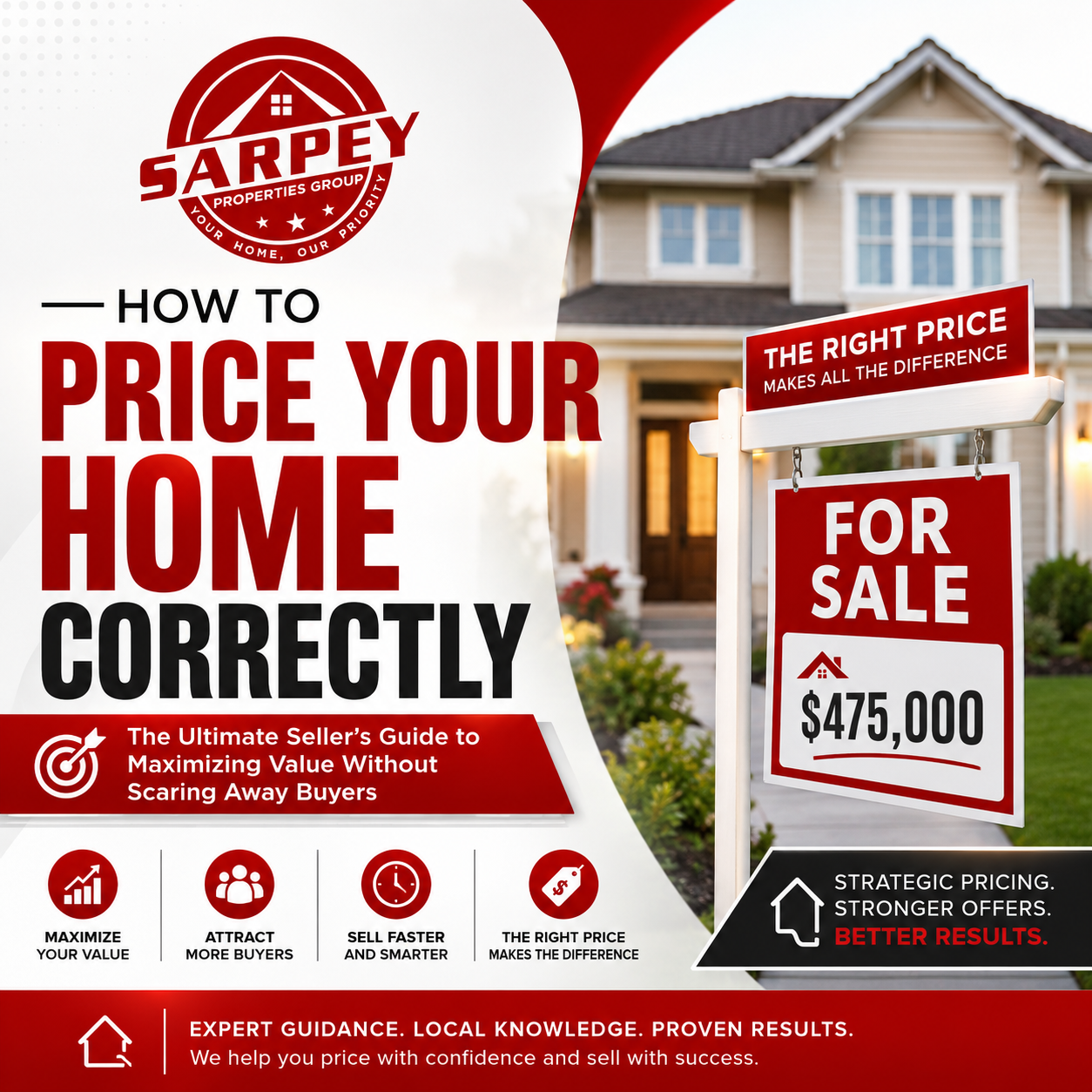
Selling Your Home? The Right Price Can Make All the Difference.
One of the biggest questions homeowners face when preparing to sell is: "How much is my home really worth?"
Price it too high, and buyers may scroll right past your listing. Price it too low, and you could leave thousands of dollars on the table. Finding that sweet spot is one of the most important factors in achieving a successful and profitable sale.
The good news? Pricing your home correctly isn't about guesswork—it's about strategy.
In this guide, we'll walk you through the key factors that influence home pricing, common mistakes sellers make, and proven strategies to help you maximize your home's value while attracting serious buyers.
Why Pricing Matters More Than Ever
Today's buyers have access to more information than ever before. Within seconds, they can compare your home to similar properties in the area and determine whether your asking price feels reasonable.
The first few weeks your home is on the market are often the most critical. A well-priced home can:
✔️ Generate more interest and showings
✔️ Attract qualified buyers
✔️ Encourage competitive offers
✔️ Reduce time on market
✔️ Maximize your final sale price
On the other hand, an overpriced home can become stale, causing buyers to wonder if something is wrong with the property.
Step 1: Understand Current Market Conditions
Before setting a price, it's important to understand the market you're selling in.
Ask yourself:
- Is it currently a buyer's market or seller's market?
- Are homes selling quickly in your neighborhood?
- How much inventory is available?
- Are mortgage rates affecting buyer demand?
Market conditions directly impact what buyers are willing to pay. Even a beautiful home may struggle if the market has shifted and pricing expectations haven't adjusted accordingly.
A knowledgeable real estate professional can help interpret these trends and position your home competitively.
Step 2: Analyze Comparable Sales (Comps)
One of the most reliable ways to determine your home's value is through a Comparative Market Analysis (CMA).
A CMA examines recently sold properties that are similar to yours in terms of:
- Location
- Square footage
- Number of bedrooms and bathrooms
- Lot size
- Age and condition
- Upgrades and features
Think of comparable sales as the "real-world evidence" of what buyers have recently been willing to pay.
While online estimates can provide a rough idea, they often fail to account for unique property characteristics and local market nuances.
Step 3: Be Objective About Your Home's Value
This can be one of the hardest parts for homeowners.
Many sellers naturally attach emotional value to their homes because of memories, renovations, and years of ownership. Unfortunately, buyers don't see those emotional investments the same way.
Try to view your property through a buyer's perspective.
Consider:
- Does the home need cosmetic updates?
- Are there deferred maintenance issues?
- How does it compare to competing listings?
Being realistic about your home's strengths and weaknesses can help you arrive at a price that attracts buyers rather than discourages them.
Step 4: Avoid the "Let's Price High and Negotiate Later" Trap
Many sellers assume they can start high and reduce the price later if needed.
While that sounds logical, it often backfires.
Here's why:
Buyers May Never See Your Home
Most buyers search within specific price ranges online. If your home is priced above market value, it may not even appear in their search results.
Longer Days on Market Can Raise Red Flags
When a listing sits unsold for an extended period, buyers begin to wonder:
- Is something wrong with the property?
- Is the seller unrealistic?
- Will there be future price reductions?
Price Reductions Can Weaken Your Position
Multiple reductions can make buyers feel they have more negotiating power, potentially leading to lower offers than if the home had been priced correctly from the beginning.
Step 5: Understand Buyer Psychology
Pricing isn't just about numbers—it's also about perception.
For example:
- A home listed at $499,900 may attract significantly more attention than one priced at $505,000.
- Strategic pricing can increase visibility in online search filters.
- Competitive pricing may generate multiple offers, driving the final sale price higher.
The goal is to create excitement and urgency among buyers, not hesitation.
Step 6: Factor in Your Home's Unique Features
Every property has characteristics that can influence value.
Potential value boosters include:
🏡 Updated kitchens and bathrooms
🏡 Finished basements
🏡 Energy-efficient upgrades
🏡 Modern flooring and fixtures
🏡 Desirable school districts
🏡 Outdoor living spaces
🏡 Smart home technology
However, it's important to remember that not every improvement adds dollar-for-dollar value. A professional pricing strategy takes these factors into account without overestimating their impact.
Step 7: Work With Local Market Experts
Accurate pricing requires more than pulling data from a website.
Experienced real estate professionals combine:
- Local market knowledge
- Neighborhood trends
- Buyer behavior insights
- Comparative sales data
- Marketing expertise
This comprehensive approach helps ensure your home enters the market positioned to attract maximum interest from qualified buyers.
At Sarpey Properties Group, we believe successful home sales begin with a strong pricing strategy. By combining local market expertise with data-driven analysis, we help sellers confidently position their homes to stand out in today's competitive market.
Common Pricing Mistakes to Avoid
Before listing your property, steer clear of these common pitfalls:
❌ Pricing based on what you "need" to make
❌ Using outdated neighborhood sales
❌ Relying solely on automated online estimates
❌ Ignoring current competition
❌ Overvaluing personal upgrades
❌ Refusing to adjust when market conditions change
Avoiding these mistakes can save valuable time and help you achieve a smoother transaction.
The Bottom Line
Pricing your home correctly is one of the most powerful tools you have as a seller.
The right price attracts more buyers, creates stronger interest, reduces time on the market, and positions you to achieve the best possible outcome.
Remember: the goal isn't simply to list your home—it's to sell it successfully.
A thoughtful pricing strategy backed by market data and local expertise can make all the difference.
Thinking About Selling? Here's a Question for You...
Would you rather have your home sitting on the market for months—or attract serious buyers from day one?
The difference often comes down to pricing.
Whether you're planning to sell next month or simply exploring your options, the team at Sarpey Properties Group is here to help you understand your home's value and develop a customized strategy designed to maximize your results.
Ready to Discover What Your Home Could Be Worth?
Contact Sarpey Properties Group today for a personalized home value consultation and expert guidance tailored to your local market.
Your next move starts with the right price—and we're here to help you get it right. 🚪🔑🏡
Categories
- All Blogs (38)
- 2026 Housing Market (2)
- Buyer Education (1)
- Buyer Resources (9)
- buyer strategy (2)
- Buyer tips (4)
- buying power (2)
- buying power, (1)
- Buying Tips (1)
- Client success stories (2)
- delaware home (1)
- Delaware Real Estate (24)
- delaware realtor (1)
- energy efficiency (1)
- First time home buyer (9)
- home affordability (2)
- Home buyer (9)
- Home buying (18)
- home buying and selling (19)
- home buying tips (7)
- home financing (3)
- home improvement (1)
- home inspections (2)
- home owner tips (2)
- home ownership (3)
- home seller tips (1)
- home sellers (2)
- home selling (10)
- home selling tips (10)
- home staging (3)
- home valuation (5)
- Homeownership (8)
- Homeownership Buyer Education (1)
- house (6)
- house buying guide (6)
- house hunting (6)
- housing market forecast (2)
- housing market trend (4)
- interest (4)
- interested rates (3)
- Lifestyle & Community Guides (1)
- Location & Lifestyle (1)
- market (7)
- market, (1)
- maryland home (2)
- Maryland Real Estate (26)
- maryland realtor (2)
- mortgage (5)
- mortgage and financing (6)
- mortgage approval (2)
- mortgage loans (1)
- open house tips (2)
- pennsylvania home (2)
- Pennsylvania Real Estate (25)
- pennsylvania realtor (1)
- property (1)
- Real Estate Advice (18)
- Real Estate Market Insights (8)
- real estate market trends (2)
- real estate marketing (7)
- real estate negotiation (3)
- real estate professionals (7)
- real estate selling tips (3)
- Real estate tips (13)
- Real estate, (13)
- Relocation & Moving (1)
- residential real estate (3)
- Sarpey (9)
- Sarpey Properties Group (10)
- seller preparation (1)
- seller resources (7)
- seller strategies (2)
- seller strategy (1)
- tax (3)
- Tri-State Real Estate (2)
- wealth building (3)
Recent Posts










"My job is to find and attract mastery-based agents to the office, protect the culture, and make sure everyone is happy! "